WHO ARE ELIGIBLE TO INITIATE CHPATER 7 BANKRUPTCY ?
Chapter 7 bankruptcy proceedings can be initiated either voluntarily or involuntarily. In voluntary cases, the financially stressed debtor himself initiates the bankruptcy proceedings while in involuntary cases, a creditor initiates bankruptcy proceedings.
In a voluntary individual Chapter 7 case, the debtor initiates the bankruptcy by filing a petition under 11 U.S.C. § 301 and seeks the protections and benefits of bankruptcy, including the automatic stay and, if eligible, a discharge. The debtor must satisfy the applicable eligibility and procedural requirements, including the requirements relating to credit counselling and, where applicable, the Chapter 7 means test. The debtor voluntarily submits to the bankruptcy court’s jurisdiction and begins the process of administration of the bankruptcy estate.
An involuntary case, governed primarily by 11 U.S.C. § 303, is fundamentally different because it is initiated by qualifying creditors rather than the debtor. Specific requirements apply concerning the number and nature of petitioning creditors and their claims. The debtor may contest the petition, and the court must determine whether the statutory requirements for an order for relief have been met. An improperly or involuntary petition filed out of bad faith may expose petitioning creditors to costs, attorney’s fees, and potentially damages under § 303(i). Thus, an involuntary case involves substantially different procedural safeguards and risks from a voluntary individual Chapter 7 filing.
ELIGIBILITIES FOR FILING VOLUNTARY CHAPTER 7 PETITION
An individual seeking to commence a voluntary Chapter 7 case must satisfy the eligibility requirements prescribed by the Bankruptcy Code, particularly 11 U.S.C. § 109. Eligibility is not determined merely by the existence of financial distress or an inability to pay debts. The debtor must meet the statutory requirements governing the filing of a Chapter 7 petition and must comply with certain pre-filing obligations.
Credit Counseling Certificate
Under 11 U.S.C. § 109(h)(1), an individual generally may not be a debtor under Chapter 7 unless, during the 180-day period preceding the filing of the petition, the individual has received an individual or group briefing from an approved nonprofit budget and credit counseling agency. The counseling must address the individual’s financial situation and generally include an analysis of possible alternatives to bankruptcy.
After completing the required counseling, the debtor ordinarily receives a certificate of completion, which must be filed with the bankruptcy court as required by the Bankruptcy Code and Federal Rules of Bankruptcy Procedure. The requirement is intended to ensure that an individual considers alternatives to bankruptcy before invoking the protections of Chapter 7. The Code provides limited exceptions and provisions for situations in which the required counseling is unavailable or an applicable emergency exists.
Restriction Following Certain Prior Dismissals
Another important limitation appears in 11 U.S.C. § 109(g). An individual is generally ineligible to be a debtor if, during the 180-day period preceding the filing of the new petition, a prior bankruptcy case was dismissed after the debtor willfully failed to obey orders of the court or to appear before the court for proper prosecution of the case, or after the debtor voluntarily dismissed the case following the filing of a request for relief from the automatic stay under § 362.
Thus, § 109(g) does not establish a blanket rule that every person whose previous bankruptcy case was dismissed must wait 180 days before filing another case. The 180 day restriction applies only when the prior dismissal falls within the specific circumstances identified in the statute. A debtor considering a new Chapter 7 filing should therefore examine the reason for the earlier dismissal, as well as the timing of the previous case, before filing a new petition.
United States Residency, Domicile, Property, or Place of Business
Under 11 U.S.C. § 109(a), an individual may generally be a debtor under Chapter 7 if, on the date of filing the petition, the individual resides or has a domicile, a place of business, or property in the United States. The provision establishes the required connection between the debtor and the United States bankruptcy system. Therefore, a person does not necessarily have to be a U.S. citizen to qualify as a debtor under the Bankruptcy Code. A non-U.S. citizen may also be eligible if the statutory jurisdictional connection exists.
The requirement is assessed as of the date the bankruptcy petition is filed. The debtor may satisfy the requirement through any one of the alternatives specified in § 109(a)—residence, domicile, place of business, or property in the United States. For example, an individual who lives in the United States may satisfy the requirement through residence or domicile. Similarly, a person who lives outside the United States may potentially qualify if the person has a business or property in the United States. The existence of U.S. property can therefore be particularly significant for individuals who are not physically residing in the country.
Means Test
One of the most important eligibility for initiating individual Chapter 7 bankruptcy is the means test. The means test is primarily intended to identify cases in which the granting of Chapter 7 relief may constitute an abuse of the bankruptcy provisions. The relevant provision is 11 U.S.C. § 707(b). The means test is particularly relevant where the debtor’s income is above the applicable median family income for the debtor’s household size and state. Certain debtors are not subject to the presumption of abuse under the means-test provisions, including individuals whose income is below the applicable median-income threshold, subject to the detailed provisions of § 707(b).
The Means Test involves the following steps :
(i) Current Monthly Income
The first important concept in the means-test calculation is Current Monthly Income (CMI). CMI is a statutory concept under the Bankruptcy Code and forms the starting point for determining whether an individual debtor is subject to the Chapter 7 means test and, where applicable, whether a presumption of abuse arises.
The term “current monthly income” is defined in 11 U.S.C. § 101(10A). Despite its name, CMI does not refer simply to the debtor’s income for the month immediately preceding the filing of the bankruptcy petition. Instead, it is generally based on the average monthly income received by the debtor during the six-month period ending on the last day of the calendar month immediately preceding the month in which the bankruptcy petition is filed. The calculation is made without regard to whether the income is taxable.
The six-month look-back period is an important feature of the CMI calculation. For example, if a debtor files a Chapter 7 petition on September 15, the relevant period generally runs from March 1 through August 31. The debtor’s income during those six months is aggregated and then divided by six to determine the monthly average, subject to the statutory rules governing what constitutes income and what amounts must be excluded.
In a joint bankruptcy case, the calculation may also take into account income received by the debtor’s spouse, subject to the provisions and exclusions contained in § 101(10A). Thus, CMI is not necessarily limited to wages or other income earned personally by the debtor. The statute establishes specific rules concerning income attributable to the debtor and, in a joint case, the debtor’s spouse.
The definition also excludes certain categories of income from the calculation. One important statutory exclusion relates to benefits received under the Social Security Act. Once CMI is determined, it is compared with the applicable median family income for the debtor’s household size and geographic area as part of the means-test analysis.
For example Ms. Sarah files a Chapter 7 bankruptcy petition on September 15, 2026. The six-month period for determining her Current Monthly Income (CMI) is therefore March 1, 2026 through August 31, 2026. During this period, Sarah received wages of $4,000 per month from her employment. She also received Social Security benefits of $1,500 per month. In addition, she received $500 per month from a rental property.
During the six-month period, Sarah therefore received total wages of $24,000, Social Security benefits of $9,000, and rental income of $3,000. Her total receipts from all these sources were $36,000. However, the Social Security benefits are excluded from the calculation of Current Monthly Income under 11 U.S.C. § 101(10A). Therefore, the $9,000 received as Social Security benefits is not included in determining her CMI.
For purposes of calculating CMI, Sarah’s includable income is therefore $24,000 in wages plus $3,000 in rental income, resulting in total includable income of $27,000 for the six-month period. Her Current Monthly Income is calculated by dividing $27,000 by six. Accordingly, Sarah’s Current Monthly Income is $4,500 per month.
(ii) Deductions from monthly income
Once the CMI has been calculated, it is multiplied by twelve to arrive at the debtor’s annualized Current Monthly Income. This annualized income is then compared with the applicable median family income for a household of the same size in the debtor’s state.
The determination of the number of members of a debtor’s household is also important because the applicable median family income varies according to household size. For purposes of the Chapter 7 means test, household size should not be determined simply by counting all persons who reside at the debtor’s address. The Bankruptcy Code does not provide a comprehensive definition of “household” for this purpose, and therefore the determination may depend upon the facts and circumstances of the particular case. Generally, the household may include the debtor, a non-filing spouse, dependent children, and other persons whom the debtor actually supports or whose income and expenses are appropriately considered part of the debtor’s economic household. A non-filing spouse may therefore be included even though the spouse is not a debtor, while a child may be included where the debtor provides substantial financial support, depending upon the circumstances. Conversely, a person who merely shares the debtor’s residence, such as a roommate, tenant, boarder, or other unrelated person who maintains separate finances, would not ordinarily be counted merely because that person lives at the same address. Similarly, a dependent child who does not reside with the debtor may still require consideration depending upon the extent of the debtor’s financial support and the applicable judicial approach.
If the debtor’s annualized Current Monthly Income is equal to or less than the applicable median family income, the debtor generally does not proceed to the detailed expense-deduction calculation under the second stage of the means test. In such a case, the debtor is not subject to the presumption of abuse that arises from the statutory means-test calculation merely because of the debtor’s income. The comparison with the applicable median family income therefore serves as an important initial screening mechanism under 11 U.S.C. § 707(b)(7).
On the other hand, if the debtor’s annualized Current Monthly Income exceeds the applicable median family income, the debtor is treated as an above-median-income debtor for purposes of the means test. This does not, by itself, mean that the debtor has abused the Chapter 7 system or that the case must be dismissed. Rather, the debtor must proceed to the second stage of the means test, in which the Bankruptcy Code requires a more detailed calculation of allowable expenses and deductions.
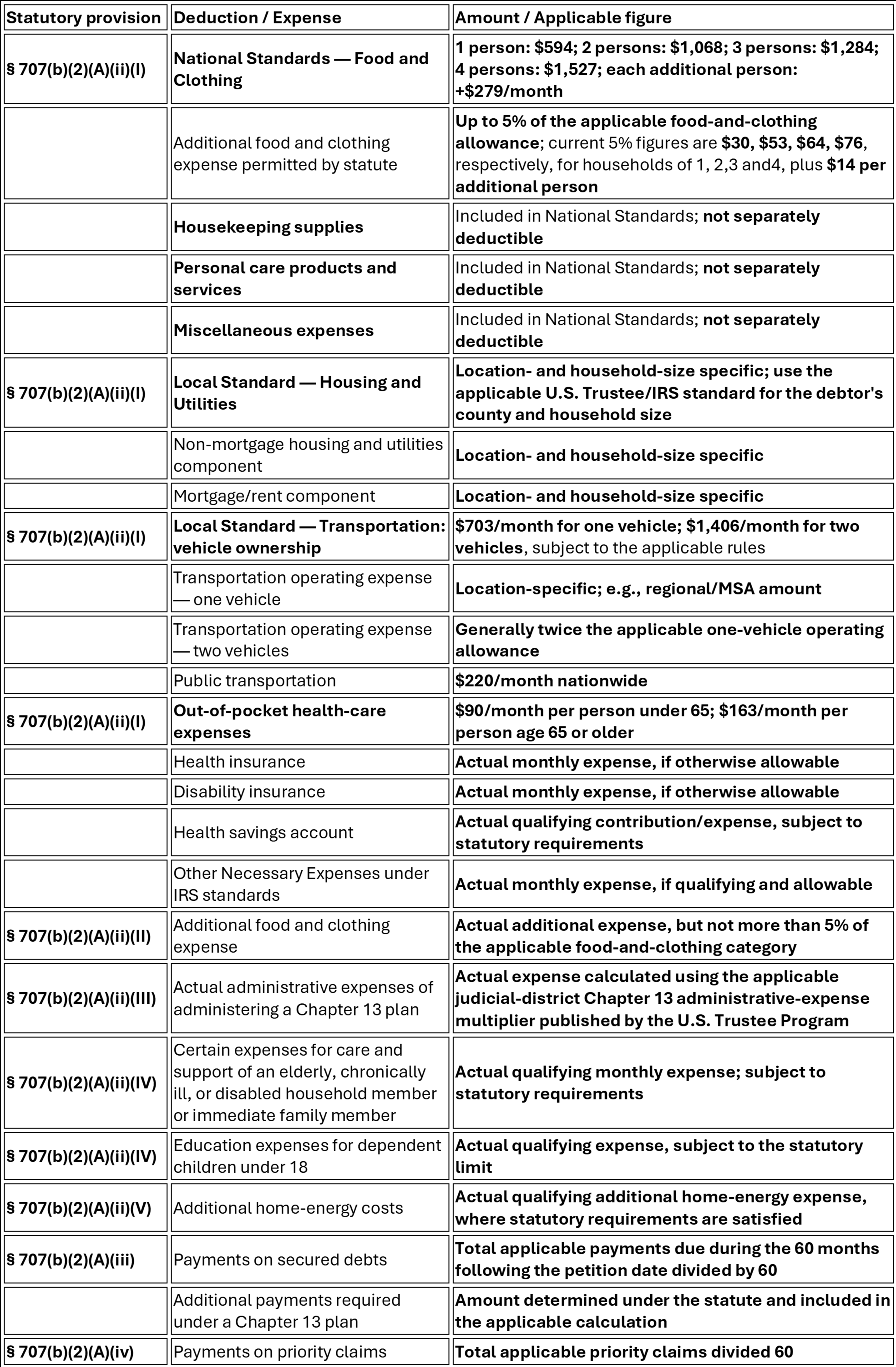
At this second stage, the debtor’s Current Monthly Income is reduced by the expenses and deductions specifically permitted under 11 U.S.C. § 707(b)(2)(A). These deductions do not simply consist of all of the debtor’s actual monthly household expenses. Instead, the Bankruptcy Code prescribes particular standards and categories of expenses, including applicable National Standards and Local Standards, certain permitted actual expenses, health-care and insurance expenses, specified additional expenses, applicable secured-debt payments, and payments on certain priority claims. Consequently, an above-median-income debtor cannot necessarily deduct every expense actually incurred by the household; the deduction must fall within a category and satisfy the requirements established by the Bankruptcy Code and applicable standards. The purpose of this second-stage calculation is to determine the debtor’s presumed disposable income available for the repayment of unsecured creditors. The expenses and deductions are summarised as under:
Suppose Mr. John files a Chapter 7 petition in September 2026. His Current Monthly Income is $8,000 per month. His annualized Current Monthly Income is therefore $96,000 ($8,000 × 12). Assume that the applicable median family income for a household of his size in his state is $75,000. Since his annualized Current Monthly Income exceeds the applicable median family income, Mr. John must proceed to the second stage of the means test under 11 U.S.C. § 707(b)(2).
For purposes of this illustration, assume that Mr. John has a four-person household and resides in Los Angeles County, California. Because the petition is filed in September 2026, the applicable expense standards are those published by the U.S. Trustee Program for cases filed on or after July 15, 2026. Under the current National Standards, the allowable amount for food and clothing (apparel and services) for a four-person household is $1,527 per month. The applicable standard also permits an additional amount of up to 5% of the food-and-clothing allowance where the statutory requirements are satisfied. Five percent of $1,527 is approximately $76 per month. The U.S. Trustee Program identifies these amounts as the Bankruptcy Allowable Living Expenses under § 707(b)(2)(A)(ii)(I).
Mr. John is also entitled to the applicable National Standard for out-of-pocket health-care expenses. For cases filed on or after July 15, 2026, the standard is $90 per month for each person under 65 and $163 per month for each person aged 65 or older. These amounts are separate from amounts actually paid for health insurance. For purposes of this example, assume that all four members of Mr. John’s household are under 65. His National Standard deduction for out-of-pocket health-care expenses would therefore be $360 per month ($90 × 4).
The applicable Local Standards for housing and utilities depend upon the debtor’s county, household size, and whether the household has a mortgage or rent. In Los Angeles County, the current standard for a four-person household is $967 per month for a non-mortgage household and $3,174 per month for a household with mortgage or rent. Assume for purposes of this example that Mr. John has a mortgage or rent. Accordingly, his applicable housing and utilities standard is $3,174 per month.
Transportation expenses are also governed by the applicable Local Standards. For cases filed on or after July 15, 2026, the transportation standard applicable to the Los Angeles Metropolitan Statistical Area provides an ownership cost of $703 per month for one vehicle and an operating-cost allowance of $365 per month for one vehicle. Assuming Mr. John has one vehicle and satisfies the applicable requirements, his transportation deduction would therefore be $1,068 per month ($703 + $365).
In addition to these standardized expenses, assume that Mr. John incurs other expenses that are permitted to be deducted under the Bankruptcy Code and the applicable means-test form. He pays $400 per month for health insurance, $100 per month for disability insurance, and contributes $150 per month to a qualifying health savings account. Assume further that he incurs $500 per month in expenses for the care and support of his elderly mother, who is a member of his immediate family and whose circumstances satisfy the statutory requirements for the deduction.
Mr. John also incurs $200 per month in qualifying administrative expenses in connection with the administration of a repayment plan. For purposes of this illustration, assume that the amount falls within the applicable statutory limitation. He has two children under eighteen years of age and incurs $600 per month in qualifying educational expenses for them. He also incurs an additional $150 per month in home-energy expenses, and assume that the expense satisfies the requirements for the applicable statutory deduction.
Mr. John also has secured debts. Assume that the payments required on his secured debts during the applicable sixty-month period amount to $60,000. The amount deductible for this purpose is calculated by dividing $60,000 by sixty, resulting in a monthly deduction of $1,000. In addition, assume that Mr. John is required to make an additional payment of $300 per month on secured debt under a Chapter 13 repayment plan. Thus, the total monthly deduction relating to secured debts is $1,300.
Finally, assume that Mr. John has priority tax claims of $18,000 that would be paid during the applicable Chapter 13 repayment period. Dividing $18,000 by sixty produces a monthly deduction of $300 for purposes of this hypothetical calculation.
The standardized expense deductions in this example can therefore be summarized as follows. Mr. John’s food-and-clothing National Standard is $1,527 per month. His out-of-pocket health-care National Standard is $360 per month, assuming four household members under age sixty-five. His housing and utilities Local Standard is $3,174 per month, based on a four-person household with mortgage or rent in Los Angeles County. His transportation Local Standard is $1,068 per month, consisting of the $703 ownership cost and $365 operating cost for one vehicle in the Los Angeles Metropolitan Statistical Area. The potential additional 5% food-and-clothing deduction is approximately $76 per month, assuming the statutory requirements are satisfied.
The remaining deductions are the qualifying health insurance, disability insurance, and health savings account expenses of $650 per month; the care and support of his elderly mother of $500 per month; qualifying administrative expenses of $200 per month; qualifying educational expenses for his two children of $600 per month; additional home-energy expenses of $150 per month; secured-debt payments of $1,300 per month; and priority tax claims of $300 per month.
Accordingly, under the assumptions of this hypothetical, the total monthly deductions would be $10,235 if the $76 additional food-and-clothing amount is included. This consists of $1,527 for food and clothing, $360 for out-of-pocket health care, $3,174 for housing and utilities, $1,068 for transportation, $76 for the additional food-and-clothing amount, $650 for health insurance, disability insurance and the health savings account, $500 for care and support of the elderly mother, $200 for qualifying administrative expenses, $600 for the children’s qualifying educational expenses, $150 for additional home-energy expenses, $1,300 for secured debts, and $300 for priority tax claims.
Because Mr. John’s Current Monthly Income is $8,000 per month, the hypothetical calculation produces negative $2,235 per month ($8,000 − $10,235). Thus, under the assumptions used in this illustration, the deductions exceed his Current Monthly Income and the resulting amount is negative rather than positive. The example demonstrates how the second stage of the means test combines standardized National and Local Standards with specified statutory deductions and other qualifying expenses. It should be emphasized, however, that the actual calculation must be completed using the debtor’s circumstances, the applicable filing-date standards, the debtor’s location and household size, and the requirements of Official Form 122A-2 and 11 U.S.C. § 707(b)(2).
(iii) Presumption of Abuse
Section 707(b)(2)(A)(i) establishes the principal means-test formula for determining whether a presumption of abuse arises in an individual Chapter 7 case. Once the debtor’s Current Monthly Income has been determined, the amounts permitted as deductions under § 707(b)(2)(A)(ii), (iii), and (iv) are deducted from that income.
The amount remaining after these deductions represents the debtor’s monthly amount for purposes of the statutory means-test calculation. This amount is then multiplied by 60, representing a period of five years. The resulting figure is intended to estimate the amount that would theoretically be available to repay creditors over a sixty-month period. The five-year figure is then compared with the statutory thresholds established by § 707(b)(2)(A)(i).
A presumption of abuse arises if the resulting sixty-month amount is not less than $10,000. In other words, where the debtor’s monthly amount remaining after the permitted deductions, when multiplied by sixty, equals or exceeds $10,000, the statutory presumption of abuse arises without the need to satisfy the alternative 25-percent test.
A presumption of abuse may also arise under the alternative test where the sixty-month amount is not less than $6,000 and that amount is not less than 25% of the debtor’s non-priority unsecured claims. The purpose of this alternative test is to take into account the relationship between the debtor’s projected five-year disposable income and the amount of the debtor’s non-priority unsecured debt. Thus, a debtor may fall below the $10,000 threshold and nevertheless be subject to a presumption of abuse if the debtor’s calculated five-year amount is at least $6,000 and represents at least 25% of the relevant non-priority unsecured claims.
For example, suppose that after applying all deductions permitted under § 707(b)(2), a debtor has $200 per month remaining. Multiplying this amount by sixty produces a five-year amount of $12,000 ($200 × 60). Because $12,000 exceeds the $10,000 statutory threshold, a presumption of abuse arises under the first part of the test.
Consider another debtor whose monthly amount after the permitted deductions is $120. Multiplying $120 by sixty produces $7,200. Although $7,200 is less than $10,000, it exceeds $6,000. Assume that the debtor has $24,000 in non-priority unsecured debt. Twenty-five percent of $24,000 is $6,000. Since the debtor’s five-year amount of $7,200 is both at least $6,000 and at least 25% of the debtor’s non-priority unsecured debt, the alternative test is satisfied and a presumption of abuse arises.
It is important to distinguish the presumption of abuse from a finding that the debtor has actually committed abuse. The means test creates a statutory presumption based upon the debtor’s financial circumstances. Where the presumption arises, the case may be subject to dismissal or conversion under the applicable provisions of the Bankruptcy Code unless the debtor successfully rebuts the presumption or another applicable provision affects the outcome. Thus, the means test serves as an objective statutory mechanism for identifying Chapter 7 cases in which the debtor appears to have sufficient income, after the deductions permitted by Congress, to repay a meaningful portion of unsecured debt.
JOINT CHAPTER 7 PETITION BY HUSBAND AND WIFE
The Bankruptcy Code permits a husband and wife to commence a joint bankruptcy case by filing a single petition. Section 302(a) of Title 11 provides that a joint case is commenced by the filing of a single petition under the applicable chapter by an individual who may be a debtor under that chapter and that individual’s spouse. Accordingly, an eligible husband and wife may file a single petition for relief under Chapter 7 rather than filing separate bankruptcy petitions. The filing of the petition constitutes an order for relief under Chapter 7.
A joint petition, however, does not transform the husband and wife into a single debtor. Each spouse is separately identified as a debtor and must satisfy the applicable requirements for eligibility and discharge. Their respective assets, liabilities, income, expenses and other financial information must be disclosed in the bankruptcy proceedings. The debts of each spouse remain subject to the rules applicable to that spouse, although jointly held property and jointly incurred debts may affect the administration of the case.
Section 302(b) further provides that, after commencement of a joint case, the bankruptcy court shall determine the extent, if any, to which the debtors’ estates are to be consolidated. Therefore, filing a joint petition does not automatically result in complete consolidation of the two estates.
Joint cases are particularly useful where spouses are jointly liable on debts or jointly own property. A joint case may reduce the costs and administrative burden associated with maintaining two separate bankruptcy cases. The filing of a joint petition also requires the participation and consent of both spouses; one spouse cannot unilaterally place the other spouse into bankruptcy.
Thus, a married couple seeking Chapter 7 relief generally has two alternatives — they may file a joint Chapter 7 case under § 302, or each spouse may file a separate bankruptcy case. The choice between the two can have significant consequences for the treatment of jointly owned property, exemptions, debts, the means test, and the administration of the bankruptcy estate.
ELIGIBILITY TO FILE INVOLUNTARY PETITION UNDER CHAPTER 7
Under § 303(a), an involuntary case may generally be commenced only against an entity that may be a debtor under Chapter 7 or Chapter 11 of the Bankruptcy Code. However, the statute excludes certain categories of entities from involuntary bankruptcy. Most importantly, an involuntary case cannot be commenced against a natural person who is a farmer or family farmer, except as permitted by the statutory provisions.
The eligibility of the alleged debtor is therefore an important preliminary consideration. Creditors cannot use § 303 to place every financially distressed person or entity into bankruptcy. The debtor must fall within the categories of entities against which an involuntary case is legally permitted.
The Bankruptcy Code establishes specific requirements concerning the petitioning creditors. Under § 303(b), the number of creditors required to commence an involuntary case depends principally upon whether the debtor has 12 or more qualifying creditors. Where the debtor has 12 or more creditors, an involuntary petition generally must be filed by three or more entities, each of which holds a claim against the debtor that is not contingent as to liability and is not subject to a bona fide dispute as to liability. In addition, the petitioning creditors must satisfy the statutory aggregate claim requirement.
Where the debtor has fewer than 12 qualifying creditors, the statute generally permits one qualifying creditor to commence the involuntary case, provided that creditor satisfies the requirements of § 303(b). Certain special rules apply to employees, insiders and holders of claims secured by exempt or insufficient collateral, and these provisions must be examined when determining whether a creditor qualifies as a petitioning creditor.
The petitioning creditors must also satisfy the minimum aggregate amount of qualifying claims prescribed by § 303(b). The statutory amount is subject to adjustment under 11 U.S.C. § 104, which periodically adjusts certain dollar amounts in the Bankruptcy Code for inflation. Accordingly, the applicable monetary threshold should always be verified for the date on which the involuntary petition is filed.
Where three or more creditors are required, their qualifying claims are generally aggregated for purposes of satisfying the statutory threshold. The calculation is based on claims that meet the requirements of § 303 and excludes claims that are contingent as to liability or subject to a bona fide dispute as to liability.
Filing a technically sufficient petition does not automatically mean that the debtor will be placed into bankruptcy. If the debtor contests the petition, § 303(h) establishes the circumstances in which the court may enter an order for relief.
One of the principal grounds is that the debtor is generally not paying such debtor’s debts as such debts become due, unless the debts that are not being paid are the subject of a bona fide dispute as to liability or certain other statutory circumstances apply.
The inquiry is therefore broader than simply asking whether the debtor has failed to pay one particular debt. The court may examine the debtor’s overall payment conduct to determine whether the debtor is generally failing to pay debts as they become due.
An alleged debtor has an opportunity to challenge an involuntary petition. The debtor may dispute whether the petitioning creditors satisfy the statutory requirements, whether their claims qualify, whether the required number of creditors has joined the petition, or whether the statutory grounds for an order for relief have been established.
This procedural protection is particularly important because an involuntary bankruptcy petition can significantly affect a person’s or business’s property, credit standing and ability to conduct financial affairs. The court therefore does not simply treat the filing of the petition as equivalent to a voluntary bankruptcy petition filed by the debtor.
The Bankruptcy Code also discourages creditors from filing involuntary petitions merely as a collection tactic or for an improper purpose. Under § 303(i), if an involuntary petition is dismissed, the court may, under the circumstances specified in the statute, award the alleged debtor costs or reasonable attorney’s fees incurred in connection with the involuntary proceeding. Where the petition was filed in bad faith, the court may also award damages proximately caused by the filing and punitive damages.
This potential liability makes it particularly important for creditors to conduct adequate due diligence before commencing an involuntary case. The creditor should ensure that the debtor is an eligible target, that the creditor’s claim qualifies, that the required number of creditors has joined where necessary, and that the statutory monetary requirements are satisfied.
__________________________________
Mukesh Suman is a lawyer based at Delhi, India. He provides bankruptcy paralegal services to US based clients. Mukesh Suman can be approached at mukesh_suman@outlook.com.